Math Anxiety & Avoidance: We Can't Even Pay People to Do Hard Math
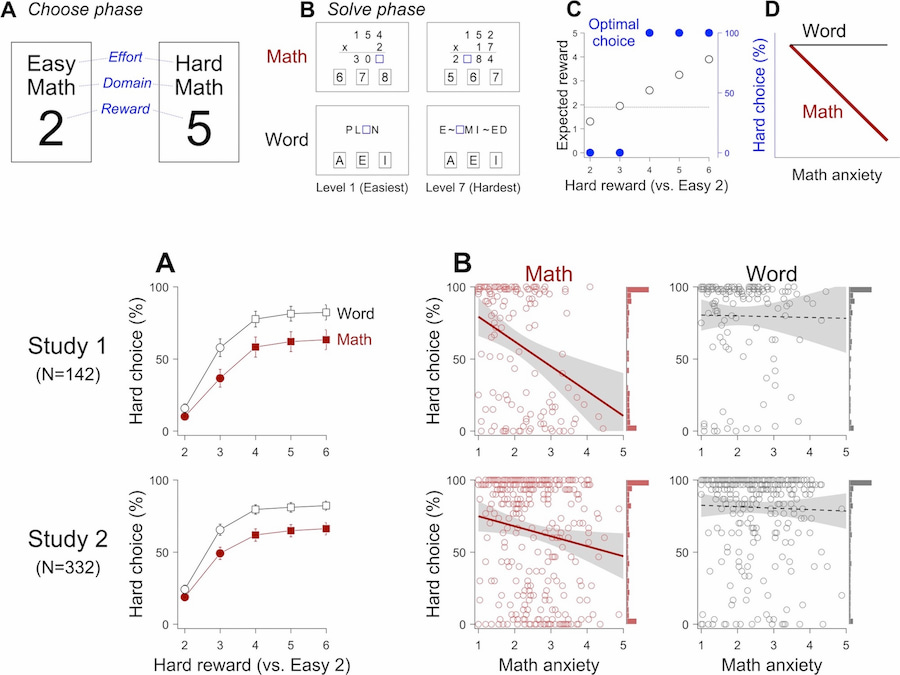
The Choose-And-Solve Task (CAST) is a novel effort-based decision-making task in which participants chose between solving easy, low-reward problems and hard, high-reward problems in both math and nonmath contexts.
Key Finding
Higher levels of math anxiety were associated with a tendency to select easier, low-reward problems over harder, high-reward math (but not word) problems, suggesting that we cannot even pay math-anxious people to do hard math.
Addressing math avoidance behaviors can help break the vicious cycle of math anxiety and increase interest and success in STEM fields.
Research Paper
Calculated avoidance: Math anxiety predicts math avoidance in effort-based decision-making Choe et al., 2019, Science Advances
Resources
- Try the demo - Experience the task yourself
- View code - Open source implementation
- Download data - Research data on OSF
- Problem set - Math and word problems used
Media Coverage
Our research was featured in several media outlets:
- @ScienceMagazine on Twitter
- @ScienceAdvances on Twitter
- UChicago News: Fear of math can outweigh promise of higher rewards
- Inverse.com: Math anxiety can make people bad at making decisions
- PERbites.org: Math anxiety and math avoidance
- 한빛사 인터뷰 (Korean)
About the Task
The Choose-And-Solve Task measures how people make effort-based decisions when faced with math versus non-math problems. Participants can choose between:
- Easy, low-reward problems (earn less money, but easier to solve)
- Hard, high-reward problems (earn more money, but more difficult)
By comparing choices in math vs. word problem contexts, we can measure math-specific avoidance behaviors that go beyond general cognitive effort avoidance.